Segment: Services
AI Solution for Services
In service companies, predictability and quality depend on clear processes and organized information between sales, operations, and customer service, not on WhatsApp transfers and disconnected spreadsheets.
In practice
How Bytebio help
- Diagnosis and operation designWe mapped the end-to-end journey (prospecting, qualification, proposal, execution, support, renewal) and the current sources (CRM, projects, finance, channels).
- Data architecture and minimum governanceWe defined a minimum model for clients, contracts, SLAs, demands, deliverables, hours, and evidence, with standardization rules.
- Strong integration with CRM and projects.We integrate CRM with task/project management and customer service channels to unify history, status, and next steps.
- Automation of routines and standardizationWe've automated information gathering, request opening, checklists, approvals, and delivery records, with clear exception rules.
Want to see the details?
Everything this page contains, organized by topic. Tap to open.
Specialized services, consultancies, offices, and technology providers thrive on consistent execution: a well-defined proposal, controlled scope, on-time delivery, documentation of what was done, and continuous demand management. In practice, operations are often scattered across CRM, email, WhatsApp, spreadsheets, project management tools, and document folders. When there is no integration and governance, rework, loss of context, conflicting promises, and difficulty measuring margins per client, service, or team arise.
A Bytebio It works to organize this scenario methodically: diagnosing what exists, designing a minimal data and process architecture, integrations and automations to reduce repetitive tasks, and a layer of traceable indicators. When it makes sense, we apply AI with clear boundaries for screening, qualification, assisted consultation of internal databases, and checks, supporting the team without creating a "black box" dependency.
Main challenges of the segment
-

Commercial and operational misalignment
Proposal information, scope, assumptions, and deadlines don't always reach the executing team in full. This generates noise, replanning, and tension with the client right from the start.
-

Demand coming from everywhere.
Requests come in via WhatsApp, email, meetings, and informal calls, without any standardized registration or prioritization. The result is an invisible queue, missed deadlines, and duplicated work.
-

Difficulty in controlling scope
Small changes accumulate and become "infinite scope" when there are no acceptance criteria, decision pathways, or request logs. The margin is lost without becoming apparent.
-

Fragmented and hard-to-find knowledge
Documents, decisions, instructions, and client history are scattered across folders and conversations. The team wastes time searching for context and repeating alignments.
-

Inconsistent productivity and margin indicators
Hours, costs, status, and deliverables are handled by different tools with varying definitions. This makes it difficult to compare clients and identify real bottlenecks.
-

Care and triage without context
Support, Customer Success, and technical teams need customer history, contracts, SLAs, and deliverables to respond quickly. Without integration between CRM, projects, and knowledge base, triage becomes trial and error.
Main challenges of the segment
-
Commercial and operational misalignment
Proposal information, scope, assumptions, and deadlines don't always reach the executing team in full. This generates noise, replanning, and tension with the client right from the start.
-
Demand coming from everywhere.
Requests come in via WhatsApp, email, meetings, and informal calls, without any standardized registration or prioritization. The result is an invisible queue, missed deadlines, and duplicated work.
-
Difficulty in controlling scope
Small changes accumulate and become "infinite scope" when there are no acceptance criteria, decision pathways, or request logs. The margin is lost without becoming apparent.
-
Fragmented and hard-to-find knowledge
Documents, decisions, instructions, and client history are scattered across folders and conversations. The team wastes time searching for context and repeating alignments.
-
Inconsistent productivity and margin indicators
Hours, costs, status, and deliverables are handled by different tools with varying definitions. This makes it difficult to compare clients and identify real bottlenecks.
-
Care and triage without context
Support, Customer Success, and technical teams need customer history, contracts, SLAs, and deliverables to respond quickly. Without integration between CRM, projects, and knowledge base, triage becomes trial and error.
How Bytebio help
-
✅ Diagnosis and operational design
We mapped the end-to-end journey (prospecting, qualification, proposal, execution, support, renewal) and the current sources (CRM, projects, finance, channels). We delivered a prioritized plan with clear dependencies, risks, and deliverables.
-
✅ Minimum data architecture and governance
We defined a minimum model for clients, contracts, SLAs, demands, deliverables, hours, and evidence, with standardization rules. We created a source trail and explicit definitions to reduce discrepancies.
-
✅ Strong integration with CRM and projects
We integrate CRM with task/project management and customer service channels to unify history, status, and next steps. We automate the creation of requests, sales handoff → operation, and stage updates with traceability.
-
✅ Automation of routines and standardization
We've automated information gathering, request creation, checklists, approvals, and delivery logs, with clear exception rules. This reduces rework and maintains consistency across individuals and teams.
-
✅ AI for screening, qualification, and assisted consultation
We apply AI to support lead and request qualification, conversation summarization, and assisted consultation on an internal basis (SOPs, standards, contracts, policies, and technical documentation). We define boundaries, human review, and controls to protect sensitive data.
-
✅ Operation, monitoring and evolution
We implemented a routine for monitoring, adjusting, and evolving integrations and automations, with backlog and prioritization. This prevents silent degradation and keeps the system useful on a daily basis.
possible results

Less rework and less friction with the client.
Recorded alignments, clearer handoffs, and retrievable history.

More controllable demand
Standardized screening and more transparent prioritization, with less "invisible queue".

More explainable margin
Hours, scope, and deliverables are reconciled to understand where the effort is being spent.

More consistent service
Faster responses with context and assisted consultation on an internal basis, reducing repeat contact.
In the service industry, technology only helps when it reduces friction between sales, execution, and customer service, and makes work more traceable and predictable. Bytebio Works with pragmatism and method to integrate CRM, operations, and data, and applies automation and AI with clear boundaries, to support consistent execution and continuous evolution.

Insights for your business
We separate the hype from the reality . Here you'll find practical analyses of AI engineering, governance, and intelligent automation, focused on what truly works for decision-makers.
-
 applied AI
How to use Claude and Codex in your company without losing governance.
Each productive individual alone does not constitute governance. Consider a three-layered diagram for using Claude and Codex in teams and development, with Notion as the source of truth.
Read the insight -
 applied AI
JEV in CRM: AI that decides in milliseconds, and what changes in Kommo with Bytebio
Generative AI writes well, but makes slow and expensive decisions. JEV does the opposite: it responds in milliseconds, with probability and confidence. See how it qualifies leads and updates the... Kommo with Bytebio and Harnz.
Read the insight -
 Internal applications
Vibe coding in the company: what separates an afternoon app from the system that supports its operation.
AI-generated app works in demo but breaks due to permission, volume, and integration issues. Understand what separates a prototype from a system that can handle operation.
Read the insight -
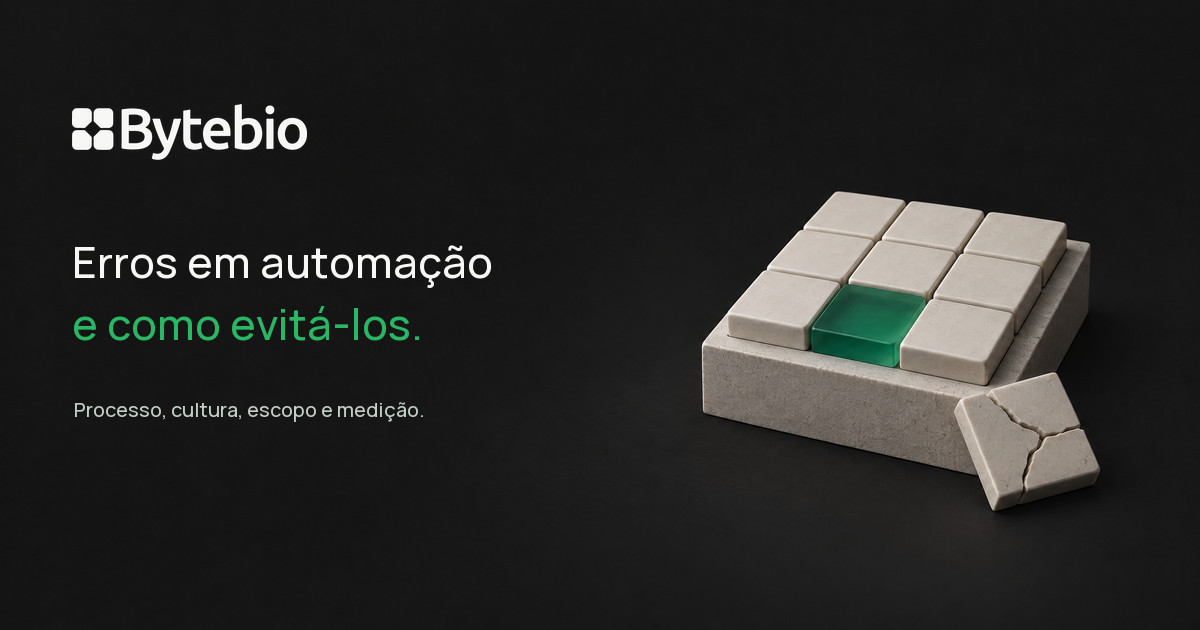 Process automation
Mistakes consultants make in automation (and how to avoid them)
Discover 4 common mistakes in automation projects and practical solutions to avoid them: process, people, scope, and measurement.
Read the insight -
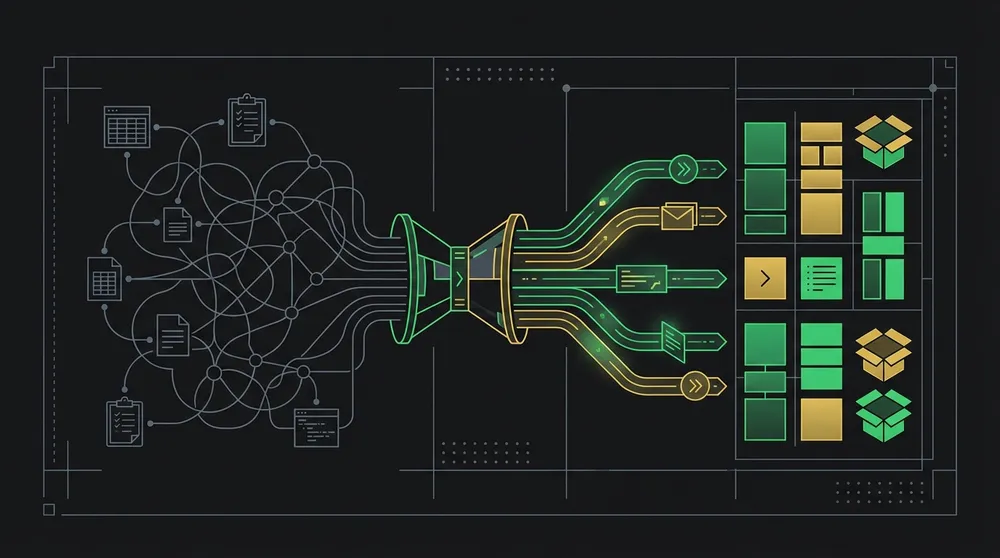 Process automation
How to reduce operational workload: a practical guide to freeing up your team.
Does your team spend hours on repetitive tasks? Discover how to identify bottlenecks and reduce operational costs with integration, automation, and applied AI.
Read the insight -
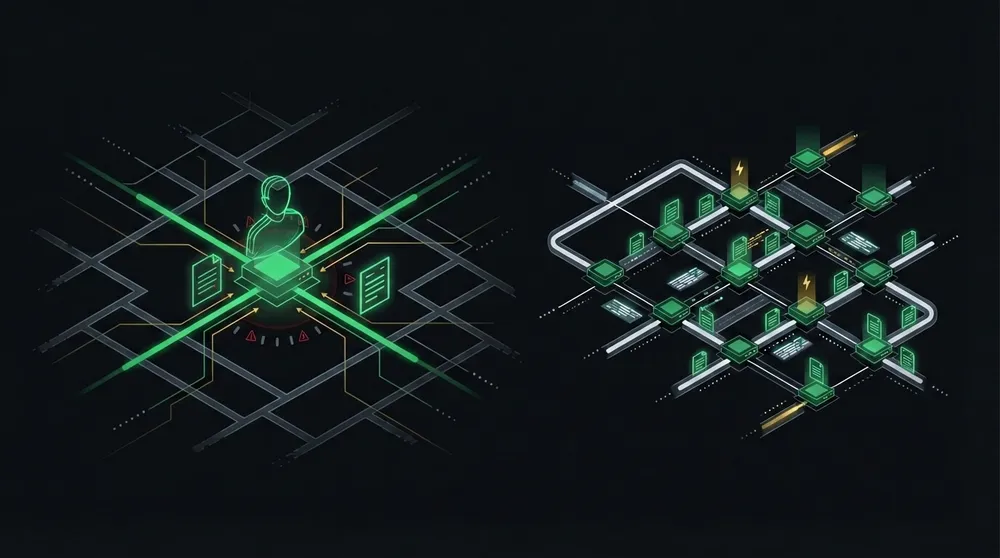 Internal knowledge
Document to avoid dependence: how to protect your operation against the departure of key personnel.
Does your operation depend on an employee who 'knows everything'? Understand the real risk of this dependency and how documenting processes protects your business from costly downtime.
Read the insight -
 applied AI
Phased AI implementation: how to get started without halting operations.
Discover how to implement AI without halting operations: parallel pilot, agreed-upon criteria before starting, and measurement before scaling.
Read the insight -
 Data and indicators
Competitive Intelligence: What your competitor knows about you (and you don't know about yourself)
Is your company operating blindly while competitors monitor you in real time? Understand how competitive intelligence and data visibility are changing the game.
Read the insight -
 Operation and support
Silent signs that your operation is about to break down (and how to fix them beforehand)
Discover the 8 operational warning signs that precede crises, how to create early alerts, and how to avoid collapses before they impact results.
Read the insight -
 Sales and CRM
CRM as an opportunity radar: redefining B2B portfolio management
Transform your CRM into an opportunity radar. Learn how to integrate ERP data to anticipate sales, reduce churn, and generate recurring revenue in B2B portfolio management.
Read the insight -
 applied AI
Beyond technology: Why AI governance defines success or failure.
Understand why AI governance is as important as the technology itself. Explore key pillars such as privacy, traceability, and compliance (LGPD).
Read the insight -
 applied AI
How do you separate AI promises from solutions that actually work?
Learn how to identify AI hype versus real solutions for your business. See warning signs, ROI metrics that matter, and practical automation case studies.
Read the insight -
 applied AI
AI Engineering: How to transform technology into real results for your business.
Discover how AI Engineering connects systems, orchestrates intelligent agents, and transforms automation into measurable results for your business.
Read the insight -
 Process automation
What should you automate first when you can't automate everything?
Learn how to decide what to automate first using objective criteria of impact, complexity, and risk. See the prioritization matrix and examples of quick wins.
Read the insight


